

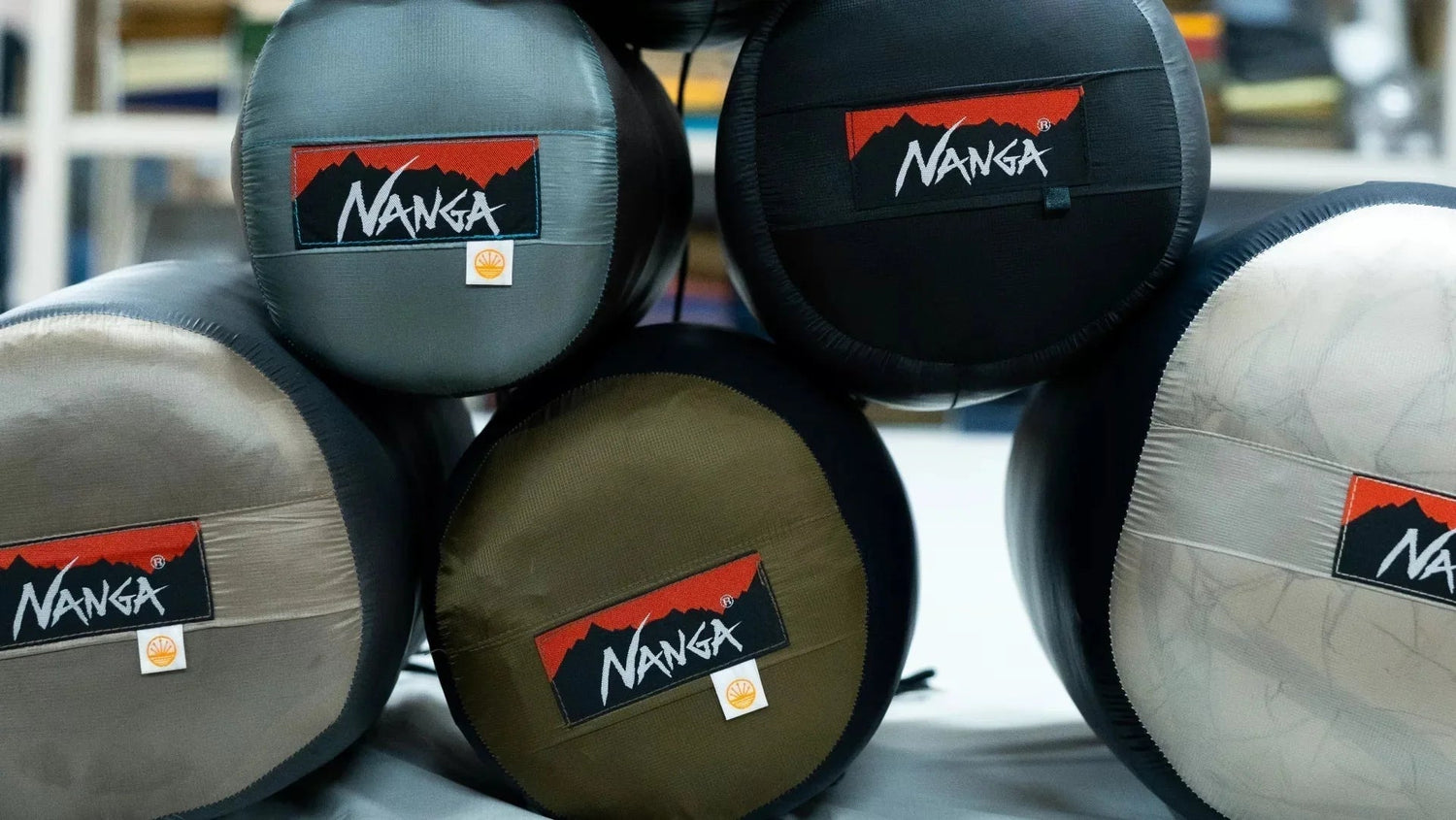
Warmth originates from the moment the scissors touch the fabric.
Nanga sleeping bags continue to evolve through exquisite craftsmanship and scientific verification, with cutting-edge technology applied to parts that are not visible to the naked eye, which is why "Nanga is a warm source of comfort."
The Beginning of Sleeping Bag Making

Maibara City in Shiga Prefecture is a thriving town that produces Japanese-style mattresses using Omi cotton as raw material.
In 1941, Yokota Komazo founded Yokota Sewing Machine as one of many small workshops supporting the local Japanese mattress industry. The company earned the recognition of major Japanese mattress manufacturers with its reliable quality, resulting in a steady stream of orders and a flourishing business.
In 1970, as the company expanded its business beyond bedding, it introduced kotatsu mattress production equipment, which became the basis for sleeping bag production that is still in use today.
In 1988, a major domestic outdoor brand commissioned the company to produce sleeping bags, and Yokota sewing machines began their history of sleeping bag production.

Accumulation of technology and knowledge
Nanga has been sewing sleeping bags since 1988. Its independent research institute , "NANGA MOUNTAIN LABORATORY," began basic research activities in 2019, culminating in the release of its first product , "LEVEL 8," in 2021. Over the years, they have accumulated extensive knowledge, technology, and craftsmanship in combining structure and feather quality, determining which feathers to use and how much to use to create better products.
However, this knowledge is based solely on subjective experience. To develop into a down jacket manufacturer capable of competing with world-class companies, data based on objective theories is crucial.
Nanga utilizes cutting-edge technology to analyze its products, quantifying their insulation performance and comfort. Furthermore, to develop new products, it sets stringent usage conditions and conducts high-level research and development in materials, structure, and quality.
Quality stems from the precision of every stitch.

The making of a sleeping bag begins the moment the fabric is cut with scissors. From cutting and sewing to filling with down, every step is handled by experienced craftsmen.
Sleeping bags used outdoors and in harsh environments require meticulous design to maximize the quality of the down filling, combined with on-site expertise and attention to every detail. This combination of factors creates their unique and exceptional qualities.
The employees in each position have diverse backgrounds, ranging from experienced senior staff who view quality from a broad perspective to younger employees who are honing their skills from scratch. Each of them is willing to accept new challenges, working together to ensure reliable product quality and create trustworthy products.
 Committed to providing high-quality feathers
 Nanga's core raw material is Spanish Murad duck down, which has numerous feathers, long and fine barbs, a dense texture, and excellent loft.
Kawada Feather Co., Ltd. employs a unique process that utilizes ultra-soft water to thoroughly clean, dry, and sort the raw materials. The company boasts one of Japan's largest refining technologies. Through meticulous removal of impurities and grease, the feathers achieve a cleanliness level of up to 2,000mm, maximizing the preservation of their natural fluffiness.
Nanga also places special emphasis on the breeding environment, cultivating feathers with good elasticity and high loft through long-term management of a breeding period of more than 80 days. This pursuit of quality in the three stages of "raw materials", "processing" and "breeding" results in high-quality feathers, which in turn enables the design of sleeping bags that make full use of these feathers.
The method to "continue use after repair"

Nanga values the philosophy of "repair and continue to use." They produce highly durable products designed for use in harsh environments, but over time, both the performance and the fabric will degrade.
They have a comprehensive after-sales service system to ensure your down products can be repaired and reused. Since the company's inception, they have consistently offered a lifetime quality guarantee for their down products, reflecting their pride in creating durable goods. The team provides repair services in their own factory and uses reliable techniques to fix products, from minor tears to adding more down, providing excellent service to their customers.
Information sourced from the official Nanga website: